
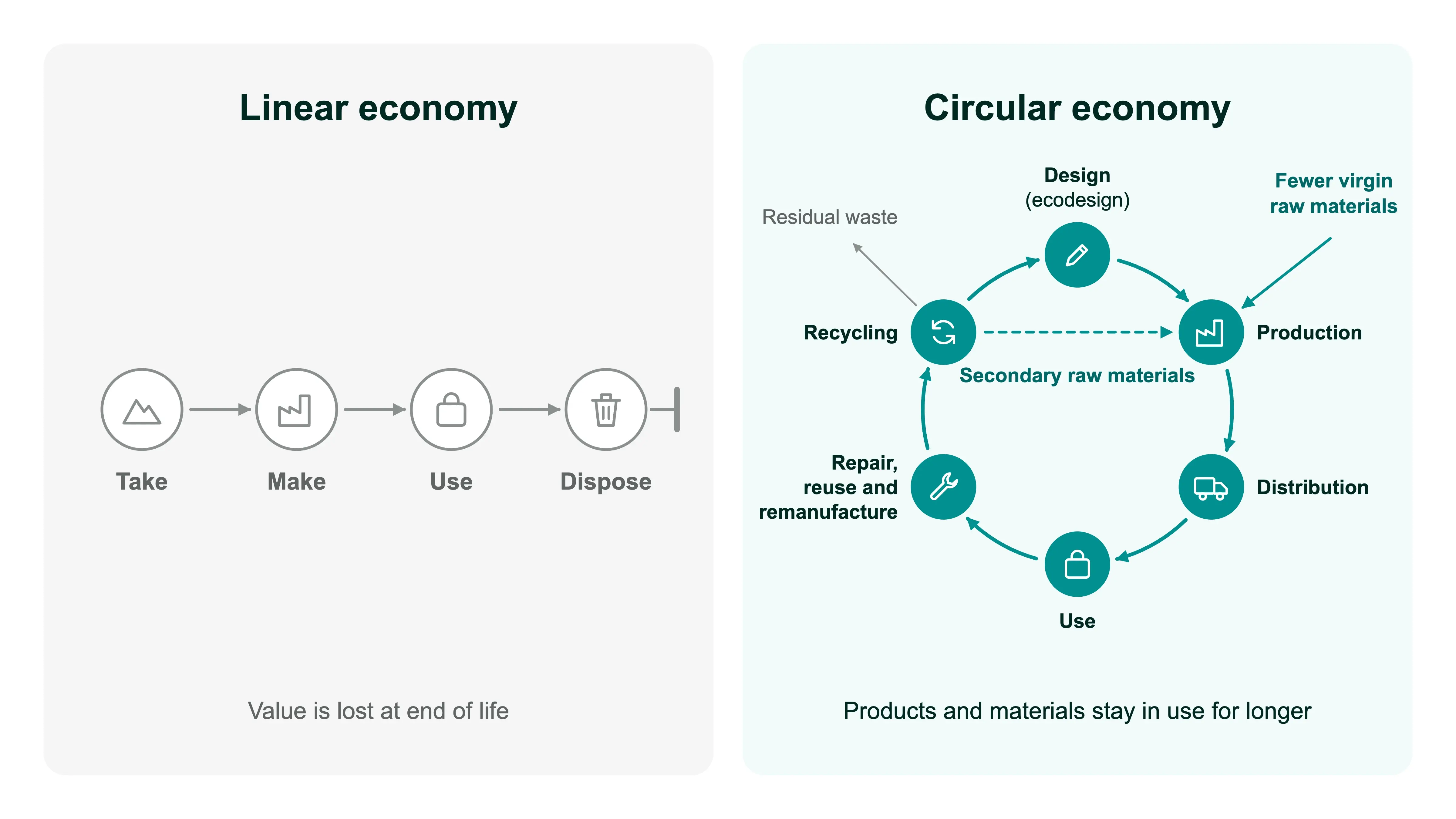
The circular economy is a model of production and consumption that keeps products, components and materials in use for as long as possible, at their highest value. Its goal is to use fewer virgin raw materials and reduce waste by extending the life of products and materials. It is a practical alternative to the linear "take, make, use, dispose" model.
|
Key takeaways:
|
We will cover:
What is the circular economy
The European Parliament describes the circular economy as a model based on sharing, leasing, reusing, repairing, refurbishing and recycling existing materials and products, to extend their life cycle. The glossary of the Circularity Gap Report 2026 adds three elements: the value of materials should be retained for as long as possible, the use of new resources kept to a minimum, and so should waste generation.
In 2017, researchers Julian Kirchherr, Denise Reike and Marko Hekkert analysed 114 definitions of the circular economy. Recycling appears in 79% of them, but only 30% set an order of priority between the different actions. Reducing the circular economy to recycling alone, however, tackles only part of the problem, without really rethinking how a company uses resources, designs products and runs its processes.
This is where one of the core principles of the circular economy comes in: "closing the loop", that is, preventing materials and resources from becoming waste and keeping them in circulation for as long as possible. Depending on the type of material, this happens in two ways:
Technical cycle – materials stay in the production system: metals, plastics, electronic components and other materials are kept in use for as long as possible through maintenance, reuse, repair and remanufacturing. When they can no longer be recovered in any other way, they are recycled.
Biological cycle – materials return to nature: organic materials, such as food waste or untreated wood, are safely returned to the environment, for example through composting or anaerobic digestion, helping to regenerate natural systems.
Take a mechanical engineering company that makes components from steel bars as an example. In a traditional model, the scrap generated during machining is collected and sold as mixed scrap metal, while worn components are simply replaced with new parts.
Applying circular economy principles means acting on several levels. First, the company can reduce the amount of material wasted in production by optimising how components are cut from the steel bars. It can then separate swarf by alloy type, so that foundries can recover it without loss of quality. Finally, it can rethink what happens after the sale, offering customers the option to overhaul and recover a worn component instead of replacing it, extending its useful life.
The circular economy, then, does not only deal with the final waste: it aims to reduce waste, preserve the value of materials and extend the life of products across the whole process.
Linear vs circular economy
The linear economy measures how much is produced; the circular economy also measures how much value is retained. The difference between the circular and the linear economy shows in six areas.
| Aspect | Linear Economy | Circular Economy |
| Material flow | Resources are extracted, processed, used and finally disposed of. | Materials and components are kept in use and fed back into production cycles. |
| Design | Focuses mainly on product cost and performance. | Considers durability, repairability, ease of disassembly and material recovery from the start. |
| End of life | The product becomes waste to be landfilled or incinerated for energy recovery. | Products and materials are reused, repaired, remanufactured or, as a last option, recycled. |
| Business model | Value comes mainly from selling new products. | Value can also come from services, rental, maintenance, repair, take-back and spare parts. |
| Supplier relationships | Selection focuses mainly on price, quality and lead times. | Origin and composition of materials, recycled content and recoverability also count. |
| Measure of value | The focus is on the number of products sold. | The focus extends to keeping products, components and materials in use and preserving their value over time. |
The linear model is still the dominant one, and the issue directly concerns manufacturers. According to Circle Economy's Circularity Gap Report, only 6.9% of the materials entering the global economy come from secondary sources; the remaining 93.1% are virgin materials.
The Circularity Gap Report 2026 illustrates this logic with the "value hill". Value builds up on the way up: extraction, production, assembly, sale. After use, circular strategies keep it high: repair, reuse, refurbishment, remanufacturing. Recycling is the last step, because it recovers the material but loses the labour and energy embedded in the product.
The same report estimates, for the first time, the economic cost of the linear model. The initial estimate is around €25.4 trillion a year (± €4.7 trillion), almost 31% of global GDP: roughly €1 lost for every €3 created. Losses in processing amount to around €904 billion; residual value lost at end of life to around €10 trillion. The authors present these as potential values, "up to", not guaranteed results.
What are the principles of the circular economy
Among the most widely used references to explain the circular economy are the three principles set out by the Ellen MacArthur Foundation:
- Eliminate waste and pollution. Waste is prevented before it has to be managed. For example: a furniture maker replaces the glues that prevent wood and laminate from being separated.
- Circulate products and materials at their highest value. First the product, then the component, finally the material. For example: a machinery manufacturer can take back worn gearboxes from customers, remanufacture them and put them back into the production cycle.
- Regenerate nature. The circular economy aims not only to reduce pressure on natural resources but also to help them regenerate. Biological materials can be safely returned to nature, helping to preserve soil fertility and nutrients. For example: a food company sends organic by-products to composting or anaerobic digestion.
Why does this approach matter for the climate? In its report Completing the picture, the Foundation calculates that renewable energy and energy efficiency address 55% of global emissions. The remaining 45% comes from making products. Applying circular economy strategies to cement, steel, aluminium, plastics and food could cut global emissions by 9.3 billion tonnes of CO₂e by 2050. That would be a 40% reduction for the four key industrial materials and 49% for the food system.
The three Rs (and beyond)
The three Rs of the circular economy are reduce, reuse and recycle, and they follow a clear order of priority. Reduce means avoiding resource use and waste generation upstream. Reuse extends a product's life by keeping it intact and in use. Recycle, finally, recovers materials when the product can no longer be used, but loses the value embedded in the product and its components.
The 9R framework, taken up by Kirchherr and colleagues, extends this ladder to ten strategies, from R0 to R9: refuse, rethink, reduce, reuse, repair, refurbish, remanufacture, repurpose, recycle, recover energy. The strategies follow an order of priority: those that avoid using new resources or keep the product intact retain more value than those that only recover materials or energy.
Circular economy and waste
The Waste Framework Directive 2008/98/EC, amended by Directive (EU) 2018/851, sets the basic rules for waste management in the European Union: it defines what waste is, when a material stops being waste and which principles to follow. Article 4 establishes the waste hierarchy, the order of priority for managing waste:
- prevention;
- preparing for re-use;
- recycling;
- other recovery, e.g. energy recovery;
- disposal.
Recycling comes only third. Each Member State transposes the hierarchy into its national waste legislation. The same directive (Articles 8 and 8a) is the basis for extended producer responsibility (EPR) schemes: whoever places a product on the market contributes to organising and financing its end of life.
What the European Union requires on the circular economy
The reference point is the Circular Economy Action Plan presented by the European Commission in March 2020. It has given rise to rules that already affect manufacturers.
| Legislation | What it requires | Who it applies to |
| Circular Economy Action Plan (2020) | Products designed to last; priority to electronics, batteries, packaging, plastics, textiles, construction, food | No direct obligations for companies: it is the Commission's strategy behind new EU rules, including the ESPR and the PPWR |
| Ecodesign for Sustainable Products Regulation (ESPR), (EU) 2024/1781 | Ecodesign requirements (durability, repairability, recycled content) and the Digital Product Passport | Manufacturers, importers and distributors of the product groups set by delegated acts |
| Packaging and Packaging Waste Regulation (PPWR), (EU) 2025/40 | Recyclable packaging, minimum recycled content in plastics, less unnecessary packaging, reuse targets | Anyone producing, importing or distributing packaging and packaged products; in application since 12 August 2026 |
| Directive 2008/98/EC and EPR schemes | Waste hierarchy; extended producer responsibility | Producers of packaging, electrical equipment, batteries and other EPR waste streams |
|
Implementing Regulation (EU) 2026/1116 (Critical Raw Materials Act) |
Lists the waste streams with critical raw material recovery potential, the basis for national programmes | Member States; batteries, WEEE, wind, vehicles, industrial pumps, catalysts and construction value chains |
| National circular economy strategies | Member State measures on EPR, ecodesign and the secondary raw materials market | Companies and public authorities in each Member State |
Regulation 2026/1116, in force since June 2026, is the most recent and extends the scope to several product categories, including permanent magnets, electric motors, printed circuit boards and industrial pumps. If your company makes or uses these components, national recovery programmes may directly affect your supply chain.
Circular economy in business: how to apply it
Applying the circular economy in a company means starting from data, not slogans. The Circularity Gap Report notes that in Europe materials account for about half of industrial costs: every kilogram lost is a cost.
- Map material and waste flows. Draw up a mass balance by department: what comes in, what leaves as product, what leaves as offcuts, scrap or packaging. Often the first result is discovering flows nobody was measuring.
- Measure impacts with an LCA. A life cycle assessment under ISO 14040 and 14044 shows where the impact is concentrated.
- Eliminate process waste with Lean. Defects, overproduction and excess stock are lost materials. Maintenance matters too: the report estimates that 25% to 50% of the depreciation of machinery and equipment is avoidable.
- Redesign product and packaging. Ecodesign means components that can be disassembled, separable materials, available spare parts. For products the regulatory reference is the ESPR; for packaging it is the PPWR.
- Engage suppliers. Most impacts sit upstream. Without supplier data you can neither measure nor improve.
Circular economy for SMEs
For an SME, going circular does not mean overhauling the whole product range at once. You can start gradually, focusing on one product, one material or one specific waste stream, using first the data the company already has.
Waste records and annual waste reports required under national law show the quantities and types of waste generated; the bill of materials shows which materials go into products; disposal invoices help identify the flows with the biggest cost impact. By cross-checking this information, the company can identify a first priority area (by weight, cost or relevance) and focus its actions there for an initial period of three to six months, then measure the results.
The role of procurement
The purchasing department decides which materials enter the company. It can turn circularity into verifiable requirements:
- recycled content declared and documented, with the calculation method;
- reusable or returnable packaging for recurring supplies;
- data for the LCA: environmental product declarations or primary process data;
- contract clauses on end-of-life take-back, spare-part availability and traceability.
The Circularity Gap Report stresses this point: collaboration along the supply chain makes secondary material flows more reliable and reduces investment risk.
Communicating circularity without greenwashing
"Recyclable", "circular", "made with recycled material" are environmental claims: they need evidence. Directive (EU) 2024/825 on empowering consumers for the green transition, which applies across the EU from 27 September 2026, bans generic environmental claims that cannot be substantiated. It also bans presenting a result that concerns only part of a product as if it applied to the whole product.
A practical rule: every claim should state the figure, the scope, the method and who verified it. "The pump housing contains 30% recycled aluminium, calculated by weight, verified by a third party" is checkable information. A generic word on a label is not.
LCA and supplier documentation are the foundations for building this data.
Circular economy FAQ
"Recyclable", "circular", "made with recycled material" are environmental claims: they need evidence. Directive (EU) 2024/825 on empowering consumers for the green transition, which applies across the EU from 27 September 2026, bans generic environmental claims that cannot be substantiated. It also bans presenting a result that concerns only part of a product as if it applied to the whole product.
A practical rule: every claim should state the figure, the scope, the method and who verified it. "The pump housing contains 30% recycled aluminium, calculated by weight, verified by a third party" is checkable information. A generic word on a label is not.
LCA and supplier documentation are the foundations for building this data. For bans and practical examples, read our article on the EU greenwashing directive.
Circular economy FAQ
Why is the circular economy important?
The circular economy is important because the linear model wastes value and drives emissions. The Circularity Gap Report 2026 estimates losses of around €25.4 trillion a year, almost 31% of global GDP. For a company the benefits are concrete: lower spending on raw materials and disposal, less dependence on suppliers exposed to crises, compliance with new EU rules.
What is the circular economy based on?
The circular economy is based on three principles defined by the Ellen MacArthur Foundation: eliminate waste and pollution, circulate products and materials at their highest value, regenerate nature. All of them start at the design stage. In practice they translate into choices about materials, product life, business models and supplier relationships.
How does the circular economy work?
The circular economy works through two cycles. In the technical cycle, metals, plastics and components are maintained, repaired, remanufactured and only recycled at the end. In the biological cycle, organic materials return to the soil as compost or digestate. The aim is to use less virgin material and retain the value of what has already been produced for as long as possible.
What are the three Rs of the circular economy?
The three Rs are reduce, reuse and recycle, in that order of priority. Reducing avoids consuming material; reusing keeps the product whole; recycling recovers only the material. Broader models add repair, refurbish, remanufacture and recover energy, up to 9Rs. The higher up the ladder you stop, the more value you retain.
What does the European Commission require on the circular economy?
The European Commission adopted the Circular Economy Action Plan in 2020. It led to the ESPR on ecodesign and the Digital Product Passport, the PPWR on packaging, in application since 12 August 2026, and measures on the recovery of critical raw materials. The waste hierarchy and extended producer responsibility remain central.
How can an SME apply the circular economy?
An SME can apply the circular economy by starting from one product or one waste stream, using data it already has: waste records, annual waste reports, the bill of materials, disposal invoices. It then measures impacts with an LCA, reduces process waste with Lean and asks suppliers for clear data and requirements. A measured result beats a generic plan.
How GFP Group can help you apply the circular economy
Green Future Project Group supports manufacturers from data to decision. We measure the impacts of products and processes with LCA and identify where to act through ecodesign and Lean. We also support you on ESPR and PPWR obligations, supplier data and verifiable environmental claims.
Want to know where to start with your product?