
For a brand, environmental impact does not depend solely on what happens inside the factory, but on choices that span the entire value chain. In the cosmetics sector, this means considering formulation, packaging, raw materials, suppliers and logistics. Understanding where emissions are concentrated is the first step towards knowing where to act.
TEAM DR JOSEPH, a South Tyrolean B Corp founded in 1986, chose to start with measurement. Together with Green Future Project Group, it calculates its Scope 1, 2 and 3 emissions, monitors its energy consumption and voluntarily supports projects for the protection and restoration of ecosystems. In 2026, it also achieved B Corp recertification and finalised its 2025 Impact Report.
We met Lena Franz, Chief Brand Officer and Head of Sustainability, to understand how data feeds into the decisions of a beauty brand, from product development to supply chain management and communication.
 Lena Franz, Chief Brand Officer and Head of Sustainability at TEAM DR JOSEPH
In this article:
The family behind TEAM DR JOSEPH
TEAM DR JOSEPH is a family business, now in its second generation. Among the siblings who run it, Lena oversees brand, creative direction, product development and sustainability: four areas that, as she explains, she sees as inseparable.
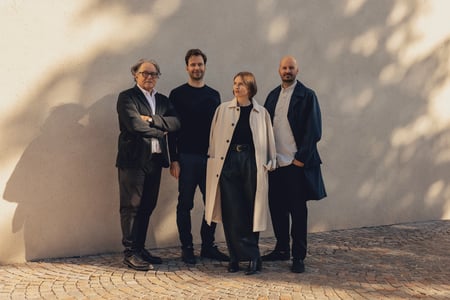
The Franz family, who run TEAM DR JOSEPH, a B Corp cosmetics company from South Tyrol
Tell us your story and your role at TEAM DR JOSEPH.
"I grew up with TEAM DR JOSEPH. The company was founded in 1986 by my father, Dr Joseph Franz, and today it is carried forward by the second generation: my two brothers, Viktor and Fabian, and me. After studying philosophy and theatre studies in Vienna, I returned to South Tyrol to continue developing the brand with my family.
As Chief Brand Officer and Head of Sustainability, I am responsible in particular for strategic brand management, creative direction and product development, as well as for developing our sustainability strategy and embedding it across the whole company. For me, these areas are inseparable: every decision about a product, a piece of packaging, a partner or our communication not only shapes how the brand is perceived, but also has ecological and social consequences. My job, therefore, is to bring aesthetics, effectiveness, innovation and responsibility together into a single, shared, long-term vision."
Corporate sustainability and B Corp certification: what it means today
If you are considering B Corp certification, be aware that the rules changed in 2026. Certification is awarded by the non-profit B Lab to companies that meet verified standards of social and environmental performance, transparency and accountability.
Until early 2026, the benchmark was the B Impact Score, the score from the B Impact Assessment, with a minimum threshold of 80 points out of 200. The new standards replace the cumulative score with mandatory requirements for each impact area. Certification is also not permanent: every recertification is a new assessment.
Today, TEAM DR JOSEPH is a B Corp certified under Standards V1.6 and is currently going through recertification under the new Standards V2.1, with the assessment completed and the audit phase under way.
How is sustainability integrated into your overall business strategy, beyond product formulations?
"For us, sustainability is not a standalone department, nor a fix applied after the fact. It is a decision-making criterion that runs through the entire company: from the selection of suppliers and packaging materials, through production, energy and logistics, to working conditions and governance.
We do not only consider environmental aspects, but also our responsibility towards our employees, partners, customers and society. This means measurable targets, clear responsibilities and regular reviews of progress. Our 2026 B Corp recertification, with a B Impact Score of 88.5 points, confirms this path, but it also shows us where we still need to grow. For us, sustainability is not a finish line we have crossed, but an ongoing process."
Sustainability and profitability: can they go hand in hand?
If you work for a product company, you know the question that comes up in every meeting: how much does it cost? A different material, a certified supplier or packaging with fewer components can all affect the price. So we asked Lena:
Was there ever a moment when you doubted that a commitment to sustainability could really be reconciled with running a profitable business?
"I have never doubted, in principle, that the two are compatible. However, there have been decisions where the more sustainable path initially proved to be more demanding, more expensive or harder to implement. Precisely because we are a family business, we must remain financially sound if we are to make a real difference in the long term.
The key is the time horizon: if you look only at short-term price, sustainability can seem like an extra cost. If, on the other hand, you take into account quality, efficiency, capacity for innovation, risk reduction and customer trust, the picture changes. For us, therefore, sustainability is not an alternative to economic success, but a prerequisite for a company that is fit for the future."
Corporate carbon footprint: the partnership with Green Future Project
The partnership between TEAM DR JOSEPH and Green Future Project has grown over time. It began with the e-commerce, where online purchases were linked to contributions towards environmental projects, and then expanded to the company's internal operations, from monitoring energy consumption to calculating its Scope 1, 2 and 3 carbon footprint.
This was an important step because it enabled TEAM DR JOSEPH to complement its support for environmental projects with efforts to measure its own carbon footprint: establishing a baseline, monitoring consumption trends and identifying where action is needed to reduce emissions and inefficiencies.
How and why did you decide to work with Green Future Project?
"We wanted to turn our ambitions into concrete, verifiable measures. Green Future Project convinced us because the partnership brings together several levels: calculating our emissions, continuously tracking and optimising our consumption data, and supporting selected projects for the protection and restoration of ecosystems.
We started with a direct link between our online shop and concrete environmental projects. We then extended the partnership to the systematic calculation of our Scope 1, 2 and 3 emissions and to the monitoring of our energy consumption. It was important to us not just to support individual projects, but to understand our own structures better and improve them continuously."
Voluntary investment in climate projects, emissions measurement, internal training and now an impact report too: we have covered every stage of the partnership in a dedicated in-depth article.
Scope 3 emissions: what emerges along the value chain
Measuring emissions also means looking beyond what happens directly within the company. For a cosmetics brand, a large share of the impact is linked to what happens along the value chain: from the purchase of raw materials and packaging to transport and the later stages of the product's life.
These are the emissions that fall under Scope 3 and, precisely because they depend on activities and parties outside the company, they are also among the most complex to collect and measure. More accurate data, however, makes it possible to understand which elements weigh most heavily on the overall footprint and, as a result, where to focus action.
Did calculating your carbon footprint make you aware of aspects of your business you had not considered before? And has this data led to changes in business decisions?
"We were already broadly aware of many these impacts. However, the calculation made them visible and comparable within an overall picture for the first time. It was particularly valuable to see that a substantial share of emissions does not arise solely at our premises, but throughout the entire value chain: materials, packaging, transport and other upstream and downstream processes.
The data has therefore, above all, helped us refine our priorities. We can monitor consumption over longer periods, identify unusual peaks and take action where measures have a real impact. This also means that, when it comes to packaging, procurement and logistics, environmental impacts can be factored into decisions on a more solid basis. Perhaps the most significant change is this: we no longer simply ask ourselves what seems most sustainable, but where, based on reliable data, we can achieve the greatest improvement.’
Communicating sustainability in the cosmetics sector
In the cosmetics sector, sustainability is increasingly becoming part of the narrative surrounding products, ingredients, packaging and processes. However, transforming a complex process into clear communication requires careful consideration: it is not enough simply to describe the initiatives undertaken; these must be backed up by concrete and verifiable information, whilst complying with regulations.
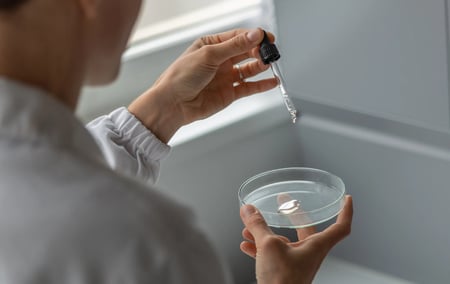 TEAM DR JOSEPH, a B Corp cosmetics company from South Tyrol
How important is it for a cosmetics brand to demonstrate its environmental commitment with concrete data rather than just statements?
"It is essential. In the cosmetics sector in particular, a great many terms are used that sound good but, on their own, mean very little. Trust therefore does not stem from fancy wording, but from transparency, clear criteria and independent verification.
Data makes progress visible, but it shows just as honestly where there is still work to do. Certifications such as B Corp or COSMOS, and emissions calculations, help to make one's claims verifiable. At the same time, numbers need to be put into context in an understandable way. Sustainability communication should neither embellish reality nor give the impression that a company has already reached its goal"
Sustainable packaging and life cycle: the cosmetic product in a B Corp
For TEAM DR JOSEPH, the challenge is to integrate effectiveness, innovation and environmental impact right from the design stage, looking beyond formulation or packaging alone.

How do you envisage the cosmetic product of the future in a B Corp like yours?
"The cosmetic product of the future will need to be effective, safe and sensorial, while using as few resources as possible. I imagine smart, concentrated, highly effective formulations, based on scientific research and on responsibly sourced natural ingredients. The product should support the skin’s natural functions, rather than creating ever-new and increasingly fleeting needs.
At the same time, packaging, the supply chain, production, use and disposal must be considered together right from the start. This means using less material, ensuring high recyclability, adopting systems that are as circular as possible, and providing transparency regarding origin and environmental impacts. In future, a truly good product will not be judged solely on what it does for the skin, but also on the footprint it leaves throughout its entire life cycle."
Advice for beauty brands getting started
We concluded with a question for those in the sector who are just starting out.
What advice would you give to other beauty companies that want to embark on a serious sustainability journey?
"My most important advice is: start, measure and stay honest. At the beginning, you do not need to have the perfect solution to every problem. But you do need to establish a solid baseline, identify the biggest impacts and, from there, set clear, verifiable targets.
Sustainability cannot be left to marketing alone. It must be backed by senior management and embedded in product development, purchasing, production, logistics and company culture. External partners and certifications can offer valuable guidance, but they do not replace your own responsibility. And you also have to talk about what has not yet been achieved. Credibility does not come from perfection, but from transparency, consistency and the willingness to keep improving."
Want to start a sustainability journey for your company?
Every company starts from different needs and priorities. Green Future Project Group supports you with software and consultancy: from measuring emissions and consumption to identifying where to act, through to supporting projects for the protection and restoration of ecosystems.
For further reading:
-
How to choose software for calculating a company’s carbon footprint
-
Green Claims Directive: prohibitions and examples of greenwashing
- PPWR: the new packaging regulations